
Old Testament · Minor Prophets · Book 31 of 66
Obadiah
The shortest book in the Old Testament: a vision about Edom, the nation descended from Jacob’s brother Esau. Edom’s pride will be brought low because it turned on its brother in his day of trouble, but on Mount Zion there will be deliverance, and the kingdom will be the LORD’s.
1 Chapter
21 verses, the shortest OT book
Author
Obadiah, “servant of the LORD”
Written
c. 848–841 B.C. (debated)
Written For
Judah, about Edom
Overview
Obadiah Summary
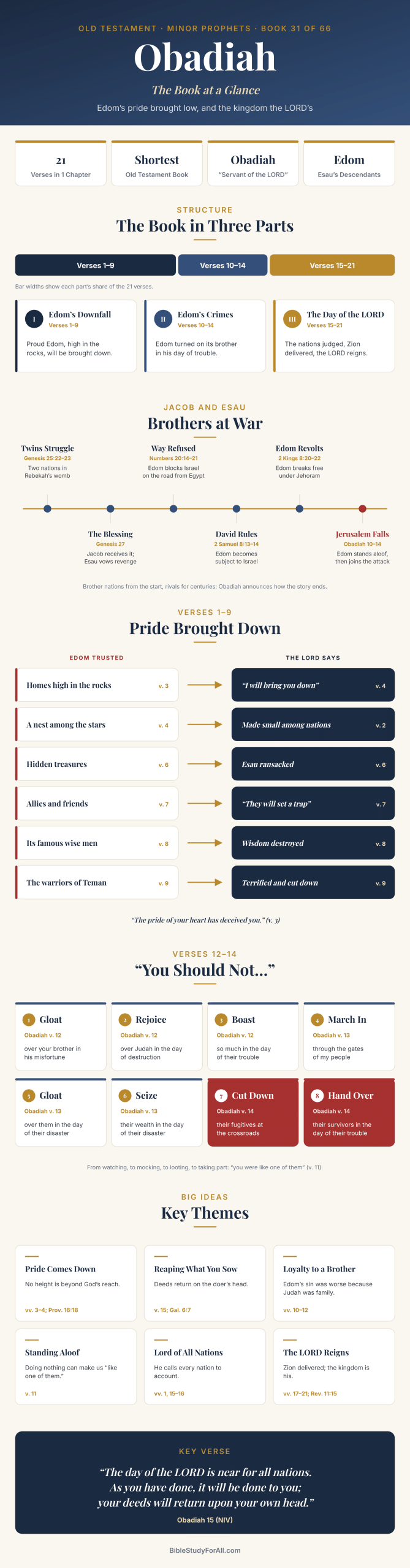
Obadiah is the shortest book in the Old Testament, only 21 verses long, and its whole message concerns one nation: Edom. The Edomites were descendants of Esau, the twin brother of Jacob, whose other name was Israel (Genesis 25:19–34; 36:1, 9). So Israel and Edom were brother nations, and the Bible often calls them that. Yet the two had been rivals from the start. The twins struggled even in their mother’s womb (Genesis 25:22–23), Jacob took Esau’s birthright and blessing (Genesis 25:29–34; 27), and Esau planned to kill him (Genesis 27:41), though years later the brothers met in peace (Genesis 33). Their descendants kept up the quarrel for centuries. Edom refused to let Israel pass through its land on the way from Egypt (Numbers 20:14–21), David conquered Edom (2 Samuel 8:13–14), and Edom later broke free from Judah (2 Kings 8:20–22).
Edom lived in the rugged red mountains south and east of the Dead Sea. Its towns sat high among cliffs and narrow gorges that were very hard to attack, and it grew rich from the trade routes that passed through its land. Edom was also known for its wisdom; one of Job’s friends, Eliphaz, came from the Edomite town of Teman (Job 2:11). All of this made Edom feel safe. Obadiah came with a message from God that this confidence was misplaced.
Verses 1–9 announce Edom’s downfall. “This is what the Sovereign LORD says about Edom,” and a messenger has gone out among the nations calling them to battle against her (v. 1). God will make Edom small and despised (v. 2). The root problem is pride: “The pride of your heart has deceived you, you who live in the clefts of the rocks and make your home on the heights, you who say to yourself, ‘Who can bring me down to the ground?’ Though you soar like the eagle and make your nest among the stars, from there I will bring you down,” declares the LORD (vv. 3–4).
Edom’s ruin will be total. Thieves take only what they want, and grape pickers leave a few grapes behind, but Esau will be ransacked and his hidden treasures searched out (vv. 5–6). The allies Edom trusted will turn on it: “those who eat your bread will set a trap for you” (v. 7). Even its famous wise men will be destroyed, and the warriors of Teman will be terrified (vv. 8–9). Edom’s mountains, friends, wisdom and strength will all fail it.
Verses 10–14 give the reason. “Because of the violence against your brother Jacob, you will be covered with shame; you will be destroyed forever” (v. 10). When foreigners broke into Jerusalem and cast lots for the city, Edom “stood aloof,” and so it was “like one of them” (v. 11). Then, in eight short commands, Obadiah lists what Edom should never have done: gloat over its brother in his misfortune, rejoice over Judah in its destruction, boast in its trouble, march through the gates of God’s people, gloat over their disaster, seize their wealth, wait at the crossroads to cut down those who escaped, and hand over the survivors (vv. 12–14). Each step went further, from watching, to mocking, to looting, to taking part in the killing.
Verses 15–21 widen the view from Edom to all nations. “The day of the LORD is near for all nations. As you have done, it will be done to you; your deeds will return upon your own head” (v. 15). Edom will reap what it sowed, and so will every nation that sets itself against God and his people (v. 16). But for God’s people the day of the LORD brings rescue: “On Mount Zion will be deliverance; it will be holy, and Jacob will possess his inheritance” (v. 17). The house of Jacob will be a fire and Esau stubble (v. 18). God’s people will again possess the land in every direction, from the Negev in the south to Zarephath in the north, and the exiles will come home (vv. 19–20). The book ends with its great promise: “Deliverers will go up on Mount Zion to govern the mountains of Esau. And the kingdom will be the LORD’s” (v. 21).
History bore out Obadiah’s words. Edom lost its homeland over the following centuries; by the time of Malachi its mountains had been laid waste (Malachi 1:2–4), and Arab peoples called the Nabateans later took over the region and its rock city of Petra. Many Edomites moved west into southern Judah, an area later called Idumea. Around 125 B.C. the Jewish ruler John Hyrcanus conquered them and forced them to adopt Jewish customs. Herod the Great, who tried to kill the infant Jesus, came from an Idumean family. After the Romans destroyed Jerusalem in A.D. 70, the Edomites disappear from history as a separate people.
Several themes run through the book. Pride goes before a fall: no height is high enough to escape God (vv. 3–4; Proverbs 16:18). Reaping what you sow: God repays nations according to their deeds (v. 15; Galatians 6:7). Loyalty to a brother: Edom’s sin was worse because Judah was family (vv. 10–12). Standing aloof is not innocent: doing nothing while others suffer can make us “like one of them” (v. 11). God rules all nations: he sends messengers among them and calls them to account (vv. 1, 15–16). The kingdom belongs to the LORD: however strong God’s enemies seem, he will deliver his people and reign (vv. 17–21). The New Testament carries these ideas forward. James and Peter both say that “God opposes the proud but shows favor to the humble” (James 4:6; 1 Peter 5:5), Hebrews uses Esau as a warning not to despise God’s gifts (Hebrews 12:16–17), and Revelation looks to the day when “the kingdom of the world has become the kingdom of our Lord and of his Messiah” (Revelation 11:15).
Readers understand some parts of Obadiah in different ways. The date is debated: some place the book in the reign of Jehoram of Judah (c. 848–841 B.C.) and others after Babylon destroyed Jerusalem in 586 B.C. (see the Date card). The link with Jeremiah 49:7–22 is explained in different ways: Jeremiah may have used Obadiah, Obadiah may have used Jeremiah, or both may have drawn on an older message. The future promises (vv. 17–21) are read by some as fulfilled in Judah’s return from exile and its later conquest of Idumea, by others as still waiting for a future fulfillment, and by many Christians as finding their full meaning in the reign of Christ, with Edom standing for every power that opposes God. “Sepharad” (v. 20) is an unknown place; many think it was Sardis in Asia Minor, while later Jewish tradition took it to mean Spain, which is why Spanish Jews are called Sephardic. This outline simply follows the text.
Obadiah at a Glance
The whole book on one page: its three parts, the long quarrel between Jacob and Esau, the pride that brought Edom down, the eight things Edom should not have done, and the key themes.
About the Name
Title
Obadiah means “servant of the LORD.” The book is named after the prophet and is the fourth of the twelve Minor Prophets, after Amos and before Jonah, and the shortest Old Testament book.
The book is named after the prophet. The Hebrew name ‘Obadyah means “servant of the LORD” or “worshiper of the LORD.” It was a common name in Israel: about a dozen different men named Obadiah appear in the Old Testament, including King Ahab’s palace steward who hid a hundred prophets from Jezebel (1 Kings 18:3–16), a leader sent by King Jehoshaphat to teach the law (2 Chronicles 17:7) and a Levite who oversaw the temple repairs under Josiah (2 Chronicles 34:12). Nothing in the book links the prophet to any of them.
In English and Hebrew Bibles Obadiah is the fourth of the twelve Minor Prophets, after Amos and before Jonah. “Minor” refers to the books’ shorter length, not their importance. In the Hebrew Bible the twelve form one book, the Book of the Twelve. Obadiah may have been placed after Amos because Amos ends by mentioning “the remnant of Edom” (Amos 9:12). With only 21 verses, it is the shortest book in the Old Testament. The New Testament does not quote it directly, but its closing words, “the kingdom will be the LORD’s” (v. 21), point toward the great announcement of Revelation 11:15.
Who Wrote It
Author Details
Obadiah wrote the book, but it tells us nothing about him beyond his name. His message shows he lived in Judah and grieved over Edom’s treatment of Jerusalem. This page follows the traditional view.
The book opens simply: “The vision of Obadiah” (v. 1). It gives no father’s name, hometown or king’s reign, so we know nothing about the prophet beyond his name and his message. From that message we can tell that he lived in Judah, loved Jerusalem and Mount Zion, and was deeply grieved by what Edom had done to his people (vv. 10–14). The word “vision” tells us that what follows came from God and not from Obadiah’s own ideas: “This is what the Sovereign LORD says about Edom” (v. 1).
Jewish and Christian tradition accepts Obadiah as the author. One old Jewish tradition in the Talmud identifies him with Ahab’s steward Obadiah (1 Kings 18), who was said to be an Edomite convert, but few readers today accept this, since that Obadiah lived about a century or more before the events the book seems to describe. Verses 1–9 are very close to part of Jeremiah’s message against Edom (Jeremiah 49:7–22), so either one prophet used the other’s words or both drew on an older prophecy. Some scholars also think the book joins two or more messages, with verses 15–21 added later, while others see it as one carefully built prophecy from a single author. This page follows the traditional view that Obadiah wrote the book.
When It Was Written
Date of Writing
Debated. This page shows the earlier view, c. 848–841 B.C., under King Jehoram, when Jerusalem was plundered. Many scholars instead date it soon after Babylon destroyed Jerusalem in 586 B.C.
The date of Obadiah is one of the most debated in the Old Testament, because the book names no king. It depends on which attack on Jerusalem verses 10–14 describe, when “foreigners entered his gates and cast lots for Jerusalem” while Edom stood by and then joined in. The earlier view links these verses to the reign of King Jehoram of Judah (c. 848–841 B.C.). In his time Edom rebelled against Judah (2 Kings 8:20–22), and Philistines and Arabs broke into Jerusalem and carried off the king’s goods and family (2 Chronicles 21:16–17). This view fits the book’s place among the early Minor Prophets and the idea that Joel and Jeremiah echo Obadiah, and it is held by a number of conservative scholars. This page shows that date, c. 848–841 B.C., while noting that it is debated.
The later view, held by most scholars today and by many conservative ones as well, connects the book to the Babylonian destruction of Jerusalem in 586 B.C. Other passages say Edom cheered and helped Babylon on that day: “Remember, LORD, what the Edomites did on the day Jerusalem fell. ‘Tear it down,’ they cried” (Psalm 137:7; see also Lamentations 4:21–22 and Ezekiel 25:12–14; 35:1–15). On this view Obadiah wrote soon after 586 B.C., probably before about 550 B.C. A few scholars suggest other dates in between. Whichever date is right, the message is the same: God saw how Edom treated its brother, and he would act.
Study Guide
Obadiah Outline
21 verses in three parts: Edom’s pride brought down (vv. 1–9), Edom’s crimes against its brother Judah (vv. 10–14), and the day of the LORD, when the nations are judged and Mount Zion is delivered (vv. 15–21). Tap any section to expand it, and tap a verse reference to read it at BibleGateway.
Part I
Edom’s Downfall
Verses 1–9 · “The pride of your heart has deceived you”: Edom’s mountain fortress, allies and wise men will not save it
Part II
Edom’s Crimes
Verses 10–14 · Violence against “your brother Jacob”: standing aloof, gloating, looting and handing over survivors
Part III
The Day of the LORD
Verses 15–21 · “As you have done, it will be done to you”: the nations judged, Mount Zion delivered, and the kingdom the LORD’s
Continue Your Study
Verse references link to the NIV at BibleGateway.