
Old Testament · Minor Prophets · Book 32 of 66
Jonah
The story of a prophet who ran from God. Sent to preach to Nineveh, the great city of Israel’s enemy Assyria, Jonah sailed the other way, was swallowed by a huge fish, and was given a second chance. When Nineveh repented and God showed mercy, Jonah was angry, and God answered him with a question about his compassion for all people.
4 Chapters
48 verses, a story about a prophet
Author
Traditionally Jonah son of Amittai
Written
c. 780–750 B.C. (debated)
Written For
Israel, about Nineveh
Overview
Jonah Summary
Jonah is unlike any other book of the prophets. Instead of a collection of messages, it is the story of one prophet and one mission, and the most surprising character in it is the prophet himself. Jonah son of Amittai was a real prophet of the northern kingdom of Israel. Second Kings 14:25 says that God spoke through him to promise King Jeroboam II (c. 793–753 B.C.) that Israel would win back its old borders, and that promise came true. Jonah’s new assignment was very different. God sent him to Nineveh, one of the great cities of Assyria, the empire that would conquer Israel in 722 B.C. The Assyrians were known for their cruelty in war, and the prophet Nahum would later call Nineveh a “city of blood” (Nahum 3:1).
Chapter 1 opens with God’s command: “Go to the great city of Nineveh and preach against it, because its wickedness has come up before me” (1:2). Nineveh lay hundreds of miles to the east. “But Jonah ran away from the LORD and headed for Tarshish” (1:3), a distant port far to the west, probably in Spain, as far in the opposite direction as he could go. He went down to the port of Joppa, paid his fare, and boarded a ship “to flee from the LORD.” Later he explains why: he feared that God would be merciful to Nineveh (4:2).
God did not let him go. “The LORD sent a great wind on the sea,” and the storm was so violent that the ship was about to break apart (1:4). The pagan sailors cried out to their gods and threw the cargo overboard, while Jonah lay asleep below deck. The captain woke him: “How can you sleep? Get up and call on your god!” (1:6). The sailors cast lots to find out who was to blame, and the lot fell on Jonah. He told them, “I am a Hebrew and I worship the LORD, the God of heaven, who made the sea and the dry land” (1:9). He told them to throw him into the sea. The sailors tried hard to row back to land instead, but finally they prayed to the LORD and threw him overboard, and the sea grew calm. Then “the men greatly feared the LORD,” offering a sacrifice and making vows (1:16). “Now the LORD provided a huge fish to swallow Jonah, and Jonah was in the belly of the fish three days and three nights” (1:17).
Chapter 2 is Jonah’s prayer from inside the fish, written as a psalm and full of phrases found in the Psalms. He looks back on his near drowning: the waters closed over him, seaweed wrapped around his head, and he sank “to the roots of the mountains.” “But you, LORD my God, brought my life up from the pit” (2:6). He contrasts “those who cling to worthless idols” with his own promise to praise God and keep his vows, and he ends with the heart of the book: “Salvation comes from the LORD” (2:9). Then the LORD commanded the fish, and it put Jonah out onto dry land (2:10).
Chapter 3 begins with the same words as chapter 1: “the word of the LORD came to Jonah a second time” (3:1). God gave him a second chance, and this time Jonah obeyed. Nineveh was “a very large city; it took three days to go through it” (3:3). Jonah walked a day into the city and announced, “Forty more days and Nineveh will be overthrown” (3:4). The response was astonishing. “The Ninevites believed God.” From the greatest to the least they fasted and put on sackcloth, the clothing of mourning (3:5). The king himself left his throne, sat in the dust, and ordered everyone, even the animals, to fast, call on God and turn from violence: “Who knows? God may yet relent and with compassion turn from his fierce anger so that we will not perish” (3:9). “When God saw what they did and how they turned from their evil ways, he relented and did not bring on them the destruction he had threatened” (3:10).
Chapter 4 shows how Jonah felt about this: “to Jonah this seemed very wrong, and he became angry” (4:1). Now he explained why he had run: “I knew that you are a gracious and compassionate God, slow to anger and abounding in love, a God who relents from sending calamity” (4:2), echoing God’s own words to Moses (Exodus 34:6). He asked God to take his life. God answered with a question: “Is it right for you to be angry?” (4:4). Jonah went out east of the city and sat in a shelter to see what would happen. God provided a leafy plant to shade him, and Jonah was very happy about it. The next morning God provided a worm that withered the plant, then a scorching east wind, and Jonah again wanted to die. God asked, “Is it right for you to be angry about the plant?” (4:9). Then came God’s final words. Jonah cared about a plant he had not planted or tended. “And should I not have concern for the great city of Nineveh, in which there are more than a hundred and twenty thousand people who cannot tell their right hand from their left, and also many animals?” (4:11). The book ends there, with God’s question left for Jonah, and the reader, to answer.
Nineveh’s turning did not last forever. About a century later the prophet Nahum announced its fall, and the city was destroyed by the Babylonians and Medes in 612 B.C. Israel, which heard many prophets, did not repent as Nineveh did, and Assyria conquered it in 722 B.C. Jesus pointed to Jonah when people demanded a miraculous sign: “For as Jonah was three days and three nights in the belly of a huge fish, so the Son of Man will be three days and three nights in the heart of the earth” (Matthew 12:40). He added that “the men of Nineveh will stand up at the judgment with this generation and condemn it; for they repented at the preaching of Jonah, and now something greater than Jonah is here” (Matthew 12:41; see also Luke 11:29–32). Jonah’s rescue from the deep became a picture of Jesus’ death and resurrection.
Several themes run through the book. No one can outrun God: the LORD is God of the sea and the dry land, and he follows Jonah wherever he goes (1:3–4, 9; Psalm 139:7–10). God rules over creation: he sends the wind and provides the fish, the plant, the worm and the east wind (1:4, 17; 4:6–8). Salvation comes from the LORD: rescue is God’s gift, not something earned (2:9). God gives second chances: to Jonah (3:1) and to Nineveh (3:10). Repentance and mercy: when people turn from evil, God is ready to relent (3:10; Jeremiah 18:7–8). God’s compassion reaches all nations: pagan sailors and Israel’s worst enemies receive his mercy, while his own prophet struggles to accept it (4:2, 11). The book invites readers to see themselves in Jonah and to share God’s heart for people they would rather avoid, the same concern that sent Jesus’ followers “to all nations” (Matthew 28:19).
Readers understand some parts of Jonah in different ways. The kind of book: many readers take it as a historical account, since Jonah was a real prophet (2 Kings 14:25) and Jesus spoke of Jonah and the people of Nineveh as real (Matthew 12:39–41), while others read it as a parable or teaching story built around a historical prophet, much like Jesus’ own parables, pointing to its carefully shaped storytelling, touches of irony, and its ending on a question. The fish: the Hebrew says only “a huge fish,” not a whale (the older word “whale” in some translations of Matthew 12:40 renders a Greek word for a sea creature); those who read the book as history see the fish as a miracle God provided, while those who read it as a parable see it as part of the story’s message. Nineveh’s repentance is not mentioned in surviving Assyrian records; some see this as a reason to read the book as a parable, while others note that the city’s turning may have been brief and that Assyrian records rarely recorded such events. “Three days to go through it” (3:3) may describe the city with its surrounding district, the time needed to cross it, or the time a visit took. The date is debated (see the Date card). This outline simply follows the text.
Jonah at a Glance
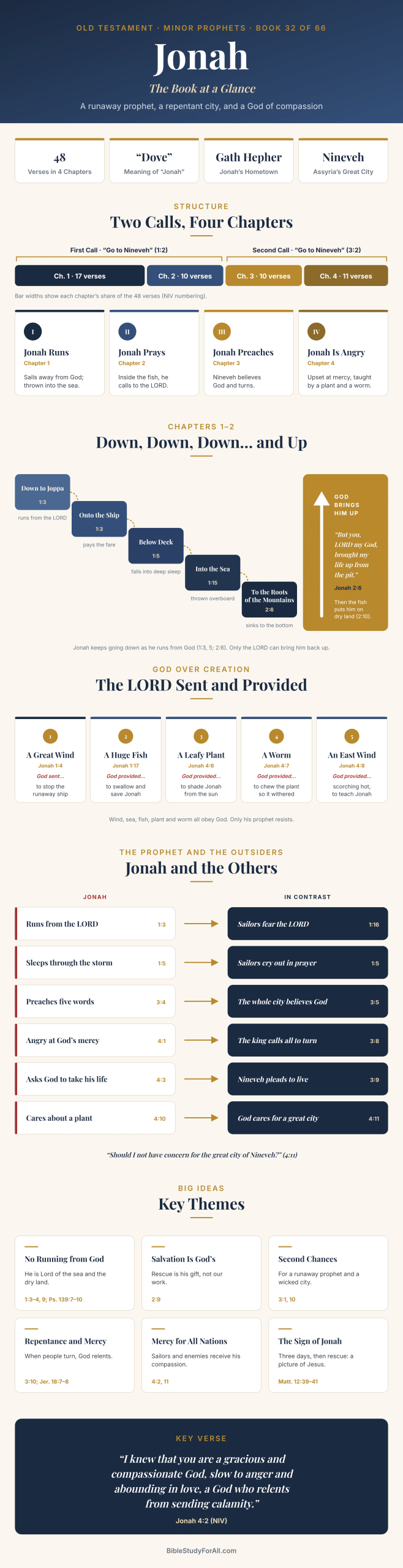
The whole book on one page: its two calls and four chapters, Jonah’s journey down and God bringing him up, the five things the LORD sent or provided, how Jonah compares with the sailors and Nineveh, and the key themes.
About the Name
Title
Jonah means “dove.” The book is named after its main character and is the fifth of the twelve Minor Prophets, after Obadiah and before Micah, and the only one that is mainly a story.
The book is named after its main character, the prophet Jonah. The Hebrew name Yonah means “dove.” His father’s name, Amittai, comes from the Hebrew word for truth or faithfulness. Jonah is mentioned outside this book in 2 Kings 14:25, which says that the LORD spoke “through his servant Jonah son of Amittai, the prophet from Gath Hepher,” promising that King Jeroboam II would win back Israel’s old borders.
In English and Hebrew Bibles Jonah is the fifth of the twelve Minor Prophets, after Obadiah and before Micah. “Minor” refers to the books’ shorter length, not their importance. In the Hebrew Bible the twelve form one book, the Book of the Twelve. Jonah is different from the other eleven: instead of a collection of prophecies, it is a story about a prophet, and Jonah’s whole recorded sermon is one sentence, only five words in Hebrew (3:4). Jesus spoke of “the sign of the prophet Jonah” (Matthew 12:39–41; 16:4; Luke 11:29–32), and Jewish congregations read the book every year on the afternoon of Yom Kippur, the Day of Atonement, because of its message of repentance and mercy.
Who Wrote It
Author Details
The book does not name its author. Tradition credits Jonah son of Amittai, a prophet from Gath Hepher in Galilee (2 Kings 14:25). Many scholars think a later author wrote it. This page follows tradition.
The book does not name its author. It tells the story about Jonah in the third person (“Jonah ran away from the LORD,” 1:3), though it includes his own prayer in chapter 2. From 2 Kings 14:25 we learn that Jonah son of Amittai came from Gath Hepher, a town in the tribe of Zebulun in Galilee, a few miles from where Nazareth would later stand (Joshua 19:13). He prophesied in the northern kingdom of Israel during or shortly before the reign of Jeroboam II (c. 793–753 B.C.), a time of strength and wealth for Israel, while the prophets Hosea and Amos were warning it about its sins.
Jewish and Christian tradition has long held that Jonah wrote the book himself, or that it was written from his own account, since only he could have told what happened inside the fish and in his conversations with God. Writing about oneself in the third person was not unusual in the ancient world. Many scholars today think the book was written by an unknown author long after Jonah’s time, using the prophet from 2 Kings as the main character of the story. This page follows the traditional view that the book comes from Jonah.
When It Was Written
Date of Writing
Debated. This page shows the traditional date, c. 780–750 B.C., in Jonah’s lifetime under Jeroboam II of Israel. Many scholars instead date the book after the exile, between the sixth and fourth centuries B.C.
The book names no king and gives no date, but 2 Kings 14:25 places Jonah in the first half of the eighth century B.C., in the time of Jeroboam II of Israel (c. 793–753 B.C.). Nineveh was then one of the great cities of Assyria, and it became the capital about 700 B.C. Those who hold the traditional view date the book to Jonah’s lifetime or soon after, around c. 780–750 B.C. Some point out that Assyria went through a weak and troubled period in these years, with revolts, outbreaks of disease and a total eclipse of the sun in 763 B.C., which may have made the people of Nineveh ready to listen to a warning, though this cannot be proven. This page shows that traditional date while noting that it is debated.
Many scholars date the book much later, after the exile, somewhere between the sixth and fourth centuries B.C. They point to words and phrases that seem to come from later Hebrew, the phrase “Nineveh was a very large city” (3:3), which may suggest the city was gone (it was destroyed in 612 B.C.), the title “king of Nineveh” instead of “king of Assyria,” and the book’s concern for how God treats other nations. Those who hold the earlier date answer that the language fits northern Israel’s Hebrew, that “was” simply describes the city at the time of the story, and that “king of Nineveh” is the kind of phrase people used for a ruler in his own city. Whichever date is right, the book’s message about God’s mercy is the same.
Study Guide
Jonah Outline
Four chapters in two halves. Each half begins when “the word of the LORD came to Jonah” (1:1; 3:1): first Jonah runs and then prays from inside the fish (1–2), then Jonah preaches, Nineveh repents, and God answers Jonah’s anger (3–4). Tap any section to expand it, and tap a verse reference to read it at BibleGateway. Verse numbers follow the NIV; in Hebrew Bibles 1:17 is 2:1, so chapter 2 is numbered one higher.
Part I
Jonah Runs from God
1:1–17 · Sent to Nineveh, Jonah sails for Tarshish; a storm, a lot cast, and a prophet thrown into the sea
Part II
Jonah’s Prayer from the Fish
2:1–10 · From inside the fish Jonah calls to the LORD: “Salvation comes from the LORD”
Part III
Nineveh Repents
3:1–10 · A second call, a five-word warning, and a whole city turning to God
Part IV
Jonah’s Anger and God’s Compassion
4:1–11 · Jonah is angry at God’s mercy, and God teaches him with a plant, a worm and a question
Continue Your Study
Verse references link to the NIV at BibleGateway.