
Old Testament · Major Prophets · Book 26 of 66
Ezekiel
A priest among the exiles sees the glory of the LORD, warns that Jerusalem will fall, and looks ahead to a new heart, new life and God dwelling with his people again.
48 Chapters
Ezekiel 1–48
Author
Ezekiel, priest and prophet
Written
c. 593–571 B.C.
Written For
Judeans exiled in Babylon
Overview
Ezekiel Summary
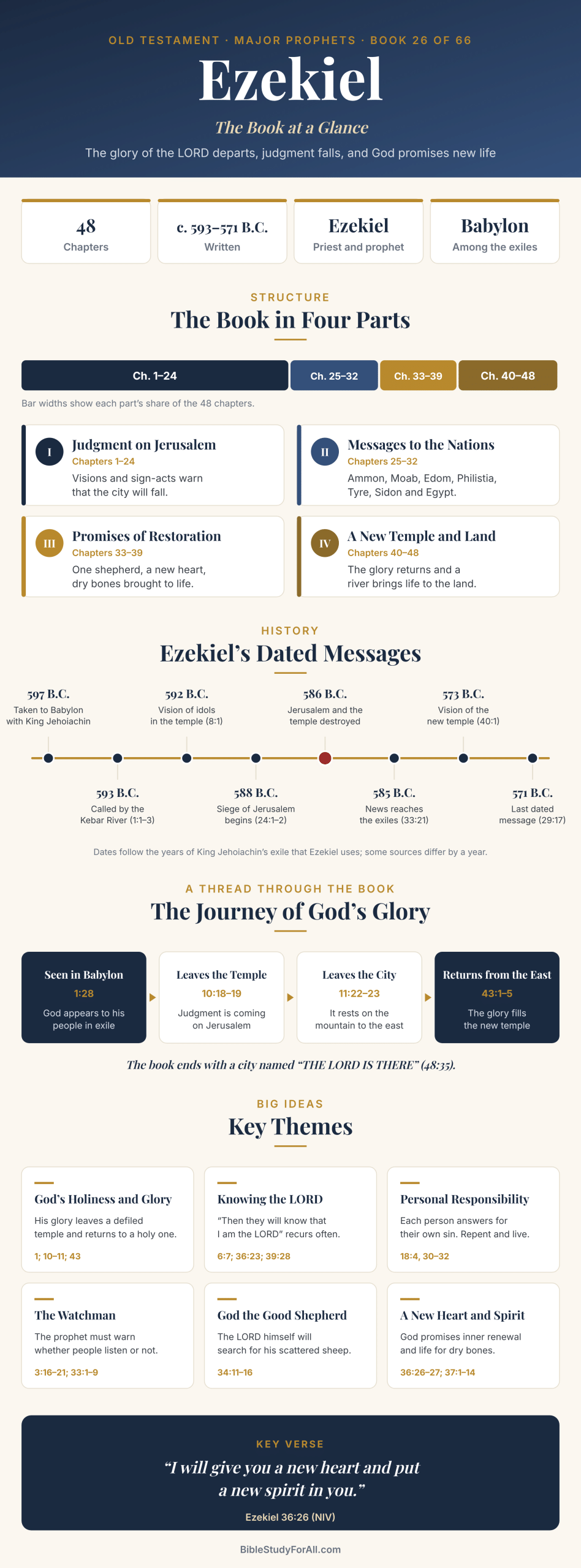
Ezekiel was a priest who was taken to Babylon in 597 B.C. along with King Jehoiachin and about ten thousand of Jerusalem’s leading citizens (2 Kings 24:10–16). Five years later, while living among the exiles by the Kebar River, he saw a vision of God’s glory: a storm, four living creatures, wheels full of eyes and a throne with a figure like a man surrounded by brilliant light. “This was the appearance of the likeness of the glory of the LORD” (1:28). God called him to speak to “a rebellious people” whether they listened or not (2:7) and appointed him “a watchman for the people of Israel” (3:17).
The book falls into four parts. Chapters 1–24 come from the years before Jerusalem fell. Many of the exiles expected to go home soon, but Ezekiel warned that the city would be destroyed. He acted out his messages with striking signs, such as a model of the siege, lying on his side for months, eating siege rations and shaving his hair. In a vision he was taken to Jerusalem, saw idolatry in the temple itself and watched the glory of the LORD leave the temple and the city (chapters 8–11). Chapters 25–32 announce judgment on the surrounding nations, especially Tyre and Egypt. Chapters 33–39 begin when a survivor arrives with the news, “The city has fallen!” (33:21), and from then on Ezekiel’s message turns to hope: God himself will shepherd his flock, give his people a new heart, bring the dry bones to life, reunite Israel and Judah and defeat Gog. Chapters 40–48 describe a vision of a new temple, the return of God’s glory (43:1–5), a river of life flowing from the temple, and a city whose name is “THE LORD IS THERE” (48:35).
Several themes run through the book. God’s glory and holiness: the glory that leaves in chapters 10–11 returns in chapter 43. Knowing the LORD: the phrase “then they will know that I am the LORD” is repeated dozens of times, showing that both judgment and rescue reveal who God is. Personal responsibility: “The one who sins is the one who will die” (18:4), and “I take no pleasure in the death of anyone… Repent and live!” (18:32). A new heart and Spirit: “I will give you a new heart and put a new spirit in you” (36:26). God as shepherd: “I myself will search for my sheep and look after them” (34:11). God often calls Ezekiel “son of man,” a title that stresses the prophet’s humanity before God’s majesty.
Readers understand some parts of Ezekiel in different ways. The temple vision (chapters 40–48) is read by some as a literal temple to be built in a future age, often linked with a coming kingdom on earth; by others as a symbolic picture of God dwelling with his people, fulfilled in Christ, the church or the new creation (compare Revelation 21–22); and by others as an ideal plan for the returning exiles that was never fully carried out. Gog of the land of Magog (chapters 38–39) is read by some as a specific end-times invasion of Israel, by others as a symbolic picture of the final defeat of all God’s enemies (compare Revelation 20:8), and by others as a vivid way of saying no future enemy will overcome God’s restored people. The lament for the king of Tyre (28:11–19), with its picture of a guardian cherub in Eden, is read by some as also describing Satan’s fall and by others as poetic language about the human king alone. This outline simply follows the text.
About the Name
Title
The book is named after the prophet. His Hebrew name, Yehezqe’l, means “God strengthens” or “may God strengthen,” a fitting name for a man God made as hard as flint against a stubborn people (3:8–9). The Greek translation (the Septuagint) spells it Iezekiel and the Latin Vulgate Ezechiel, which gives the English form Ezekiel. The name appears in the book only twice (1:3; 24:24), since God usually addresses him as “son of man.”
In English Bibles Ezekiel is the third of the Major Prophets, after Isaiah, Jeremiah and Lamentations, and before Daniel. In the Hebrew Bible it is one of the Latter Prophets, placed after Jeremiah and before the Book of the Twelve.
Who Wrote It
Author Details
The book presents itself as the work of Ezekiel son of Buzi, a priest (1:3), and nearly all of it is written in the first person (“the word of the LORD came to me”). He was taken to Babylon in 597 B.C., lived in a house at Tel Aviv by the Kebar River (3:15; 8:1), where the elders of the exiles came to consult him, and was married until his wife died suddenly during the siege of Jerusalem (24:15–18). His priestly background shows in his concern for the temple, holiness and clean and unclean things. Jewish and Christian tradition accepts Ezekiel as the author. The Talmud says the “men of the Great Assembly” wrote down Ezekiel, which is usually understood to mean they copied or arranged the book, not that they composed it.
When It Was Written
Date of Writing
Ezekiel dates many of his messages by the years of King Jehoiachin’s exile (1:2). His call came in the fifth year, 593 B.C., and the latest dated message is from the twenty-seventh year, 571 B.C. (29:17). News of Jerusalem’s fall reached him in the twelfth year (33:21), around 585 B.C., and the temple vision is dated to the twenty-fifth year, 573 B.C. (40:1). The “thirtieth year” in 1:1 is most often understood as Ezekiel’s age when his ministry began, the age at which priests began serving. Those who hold that Ezekiel wrote the book place it during these years, c. 593–571 B.C., with the book finished not long after.
Scholars who see later editing generally date the book’s final form to the later years of the exile or soon after the return from Babylon in 538 B.C., in the late 500s or early 400s B.C. The book was written for the Judeans in exile in Babylon, first to explain why Jerusalem had to fall and then to give them hope that God had not abandoned them.
Study Guide
Ezekiel Outline
48 chapters in four parts: judgment on Jerusalem (1–24), messages against the nations (25–32), promises of restoration (33–39) and the vision of a new temple and land (40–48). Tap any section to expand it, and tap a verse reference to read it at BibleGateway.
Part I
Ezekiel’s Call and Judgment on Jerusalem
1:1–24:27 · Visions, sign-acts and warnings before the city falls
- Among the exiles by the Kebar River · 1:1–3
- Four living creatures in the storm · 1:4–14
- The wheels full of eyes · 1:15–21
- The throne and the glory of the LORD · 1:22–28
- Sent to a rebellious people · 2:1–7
- Eating the scroll · 2:8–3:3
- Sent to the house of Israel · 3:4–11
- Seven days among the exiles at Tel Aviv · 3:12–15
- Appointed a watchman · 3:16–21
- Bound and silenced until God speaks · 3:22–27
- Carried to Jerusalem; the idol of jealousy · 8:1–6
- Elders worshiping images in secret · 8:7–13
- Women mourning Tammuz · 8:14–15
- Men bowing to the sun · 8:16–18
- A mark on those who grieve; the executioners · 9:1–11
- Coals of fire from among the cherubim · 10:1–8
- The cherubim and the wheels · 10:9–17
- The glory leaves the temple threshold · 10:18–22
- Judgment on the leaders; the death of Pelatiah · 11:1–13
- Promise of an undivided heart and a new spirit · 11:14–21
- The glory leaves the city · 11:22–25
- Jerusalem, a useless vine · 15:1–8
- The abandoned infant made beautiful · 16:1–14
- Jerusalem’s unfaithfulness · 16:15–34
- Judgment on the unfaithful city · 16:35–43
- Worse than Samaria and Sodom · 16:44–58
- An everlasting covenant remembered · 16:59–63
- Two eagles and a vine · 17:1–10
- The meaning: Zedekiah’s broken oath · 17:11–21
- A tender shoot from the cedar · 17:22–24
- “The one who sins is the one who will die” · 18:1–20
- “Repent and live!” · 18:21–32
- A lament for the lion cubs, Judah’s princes · 19:1–9
- A lament for the uprooted vine · 19:10–14
- The elders inquire; rebellion in Egypt · 20:1–9
- Rebellion in the wilderness · 20:10–26
- Rebellion in the land · 20:27–29
- Judgment and a future gathering · 20:30–44
- Fire in the forest of the south · 20:45–49
- The LORD’s sword drawn · 21:1–17
- Babylon’s king at the fork in the road · 21:18–27
- A sword against the Ammonites · 21:28–32
- The bloodshed and sins of Jerusalem · 22:1–16
- Silver melted in the furnace · 22:17–22
- Princes, priests, prophets and people · 22:23–31
- Two sisters, Oholah and Oholibah · 23:1–4
- Oholah (Samaria) and Assyria · 23:5–10
- Oholibah (Jerusalem) and Babylon · 23:11–21
- Judgment on Oholibah · 23:22–35
- Both sisters judged · 23:36–49
- The cooking pot: the siege begins · 24:1–14
- The death of Ezekiel’s wife · 24:15–27
Part II
Messages Against the Nations
25:1–32:32 · The LORD judges Israel’s neighbors, Tyre and Egypt
- Tyre will be destroyed · 26:1–14
- The coastlands tremble at her fall · 26:15–21
- A lament for Tyre, the great ship · 27:1–11
- Tyre’s trading partners · 27:12–25
- The ship sinks · 27:26–36
- Against the ruler who says “I am a god” · 28:1–10
- A lament for the king of Tyre, once in Eden · 28:11–19
- Against Sidon · 28:20–24
- Israel gathered and living in safety · 28:25–26
Part III
Promises of Restoration
33:1–39:29 · After Jerusalem falls: new shepherds, new hearts, new life
- Against Israel’s shepherds · 34:1–10
- The LORD will shepherd his flock · 34:11–16
- Judging the flock; one shepherd, my servant David · 34:17–24
- A covenant of peace · 34:25–31
- Against Mount Seir (Edom) · 35:1–15
- Hope for the mountains of Israel · 36:1–15
- For the sake of my holy name · 36:16–23
- A new heart and a new spirit · 36:24–32
- The land like the garden of Eden · 36:33–38
- Gog gathers the nations · 38:1–9
- Gog’s plan against a peaceful land · 38:10–16
- The LORD’s judgment on Gog · 38:17–23
- Gog falls on the mountains of Israel · 39:1–8
- Burning the weapons and burying the dead · 39:9–16
- A great feast for the birds and beasts · 39:17–20
- Israel restored and the Spirit poured out · 39:21–29
Part IV
The Vision of a New Temple and Land
40:1–48:35 · The glory returns, worship is ordered and the land is shared
- The man with the measuring rod · 40:1–4
- The east gate · 40:5–16
- The outer court · 40:17–19
- The north and south gates · 40:20–27
- The gates of the inner court · 40:28–37
- Rooms for sacrifices and for the priests · 40:38–47
- The portico of the temple · 40:48–49
- The sanctuary and the Most Holy Place · 41:1–4
- The side rooms and the west building · 41:5–12
- Measurements, carvings and doors · 41:13–26
- Rooms for the priests · 42:1–14
- The outer wall · 42:15–20
- The east gate shut; the prince’s place · 44:1–3
- Foreigners and the Levites · 44:4–14
- The Zadokite priests · 44:15–31
- The sacred district · 45:1–8
- Honest rulers and honest measures · 45:9–12
- Offerings brought to the prince · 45:13–17
- Passover and the festivals · 45:18–25
- Worship on Sabbaths and New Moons · 46:1–15
- The prince’s inheritance · 46:16–18
- The temple kitchens · 46:19–24
Continue Your Study
Verse references link to the NIV at BibleGateway.