
New Testament · Gospel · Book 43 of 66
Gospel of John
The Gospel of the Word made flesh: Jesus, the Son of God, written that all who read may believe and have life in His name.
21 Chapters
John 1–21
Author
John the Apostle
Written
c. A.D. 80 – 95
Written For
All Who Would Believe
Overview
Gospel of John Summary
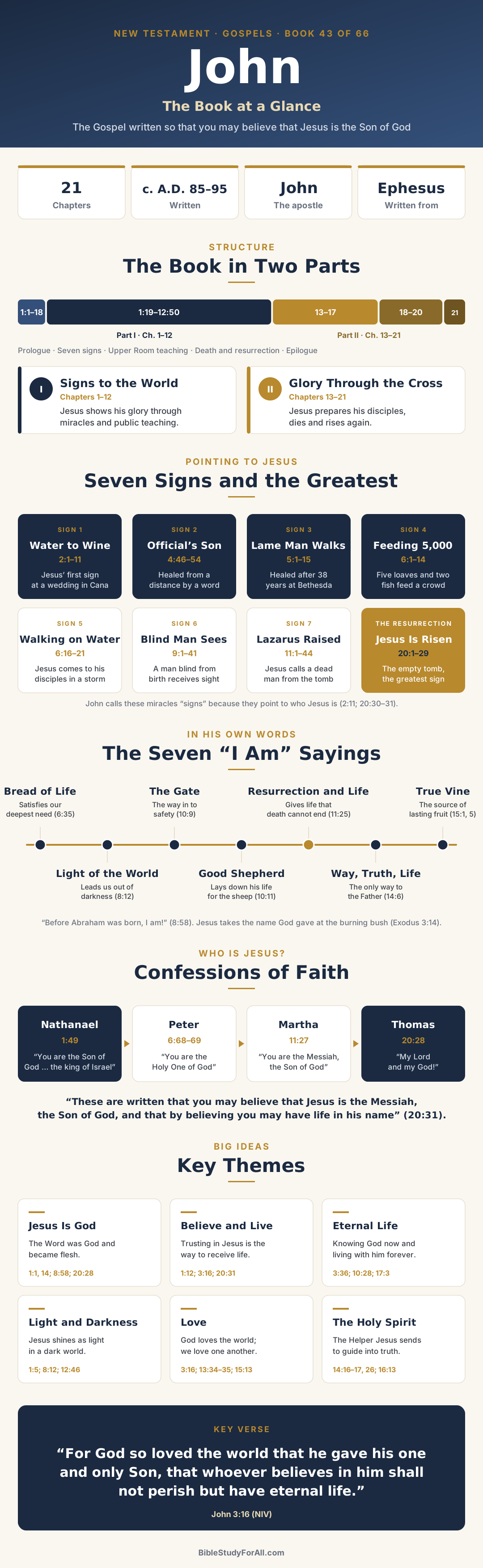
John is the fourth Gospel and differs in style from the first three. It opens not with a birth or a baptism but with the eternal Word: “In the beginning was the Word, and the Word was with God, and the Word was God” (1:1), who became flesh and lived among us (1:14). Much of the material is not found in Matthew, Mark or Luke, including the conversations with Nicodemus and the Samaritan woman, the raising of Lazarus, the washing of the disciples’ feet and the long teaching in the upper room.
The first half (chapters 1–12) is built around seven signs, miracles that point to who Jesus is, such as water turned to wine, the feeding of the five thousand, the healing of a man born blind and the raising of Lazarus. They are joined to seven “I am” sayings, including “I am the bread of life” (6:35), “I am the light of the world” (8:12), “I am the good shepherd” (10:11) and “I am the way and the truth and the life” (14:6). The second half (chapters 13–21) follows Jesus’ last evening with His disciples, His arrest, crucifixion and resurrection.
John states its purpose plainly: these things “are written that you may believe that Jesus is the Messiah, the Son of God, and that by believing you may have life in his name” (20:30–31).
About the Name
Title
The traditional Greek title is Kata Iōannēn, “According to John.” The word “gospel” comes from the Old English godspel, “good news,” which translates the Greek word euangelion.
John is often called the Fourth Gospel. Its opening echoes Genesis 1:1 and presents Jesus as the Word (Logos) who was with God and was God.
Who Wrote It
Author Details
The Gospel does not name its author, but it identifies the source of its testimony as “the disciple whom Jesus loved” (21:20–24). Early church tradition identifies him as John the apostle, the son of Zebedee and brother of James, one of the inner circle with Peter (Mark 5:37; 9:2; 14:33).
The same tradition also connects John with the three letters of John and, in most views, Revelation.
When It Was Written
Date of Writing
The date is debated, and this page gives a range of about A.D. 80–95. Church tradition places John as the last Gospel written, late in the apostle’s life. Some scholars propose an earlier date, before A.D. 70, pointing to the way the Gospel describes Jerusalem (5:2).
Early tradition connects John with Ephesus in Asia Minor in his later years. The Gospel explains Jewish customs (2:6; 19:40) and translates Aramaic words (1:38, 41–42), which suggests readers who were not all familiar with them.
Study Guide
John Outline
21 chapters in five parts. Tap any section to expand it, and tap a verse reference to read it at BibleGateway.
Part I
Prologue
1:1–18 · The Word became flesh
Part II
The Public Ministry: Signs and Sayings
1:19–12:50 · Seven signs and the “I am” teachings
Read this passage · 1:35–51
Read this passage · 2:1–12
Read this passage · 2:13–25
Read this passage · 3:1–21
Read this passage · 3:22–36
Read this passage · 4:1–42
Read this passage · 4:43–54
Read this passage · 7:53–8:11
Read this passage · 10:1–21
Read this passage · 10:22–42
Read this passage · 12:1–11
Part III
The Upper Room
13:1–17:26 · Jesus’ last evening with His disciples
Continue Your Study
Verse references link to the NIV at BibleGateway.